
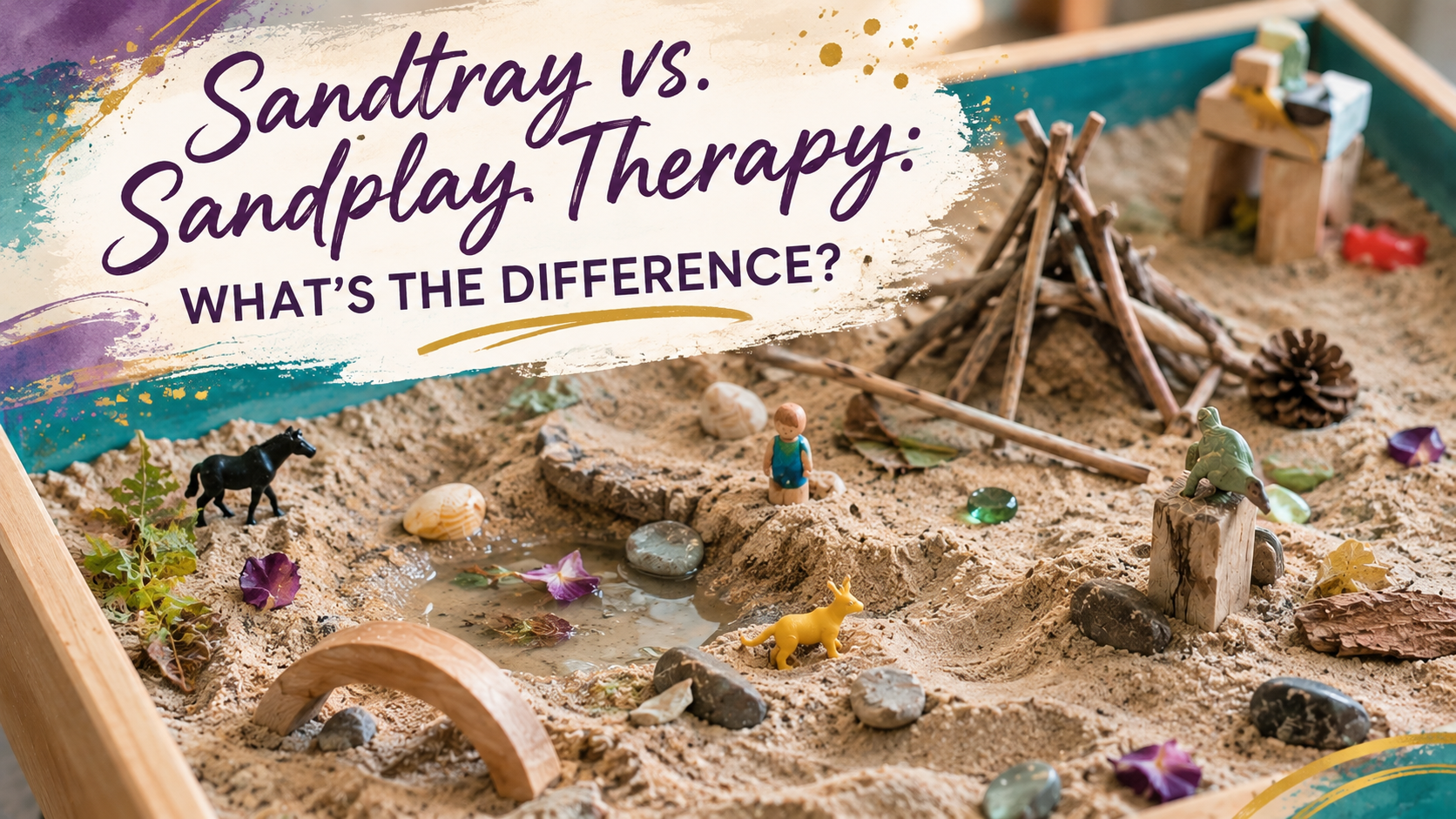
Tiny Worlds, Big Feelings, and the Magic of Creative Exploration
Have you ever watched someone become completely absorbed in creating a tiny world?
Maybe they're carefully arranging animals around a pond, building mountains, burying treasures, or placing miniature figures in a scene that seems to tell a story all its own.
From the outside, it might look like they're just playing.
But sometimes, there's a whole lot more happening beneath the surface.
At HeARTS for Hope Therapy, we've been using Sandtray and Sandplay methods in our clinical work for years. And one of the things we love most about these approaches is that they offer something traditional talk therapy doesn't always provide:
A way to explore our inner worlds without having to find all the right words.
Although Sandtray Therapy and Sandplay Therapy share similar materials, they have different roots, intentions, and therapeutic approaches.
So, what's the difference?
Let's dig in. (Pun absolutely intended.)
First Things First: Why Sand?
Think about the last time you sat at the beach and absentmindedly ran your fingers through the sand.
Maybe you made little mountains, traced patterns, or watched the grains slip between your fingers.
There's something wonderfully sensory about working with sand. It invites curiosity, movement, and engagement beyond our thinking minds.
Now add miniature trees, animals, people, bridges, houses, mythical creatures, and all sorts of tiny treasures.
Suddenly, you have the ingredients to create an entire world.
A world that can be built, rearranged, taken apart, and rebuilt.
Sometimes the worlds we create reflect something happening within us.
A bridge might represent connection. A wall might bring up themes of protection. A tiny figure standing alone might connect with a feeling we haven't quite found the words for.
Or maybe that dragon is just a dragon!
The important thing is that the meaning belongs to the person creating the world, not someone else deciding what every object represents.
This is part of what makes sand-based approaches so fascinating.
What Is Sandtray Therapy?
Sandtray Therapy is an expressive, experiential therapeutic approach that uses sand and miniature objects to explore emotions, relationships, experiences, and internal patterns.
Think of it as giving your inner world a place to take shape.
Sandtray Therapy can be more actively facilitated and integrated with a variety of psychotherapy approaches.
Depending on the client's needs, a therapist might invite someone to create a scene around a particular feeling, memory, relationship, or life experience.
For example:
What would safety look like if you could build it?
Create a world that represents how life feels right now.
What might the different parts of yourself look like?
If your healing journey were a landscape, what would it look like?
Other times, the invitation might be completely open-ended.
Once a world is created, the therapist may gently invite reflection, exploration, and curiosity about what has emerged.
Imagine building a landscape where one side feels chaotic and overwhelming, while the other holds a peaceful forest.
What would happen if you built a bridge between the two?
What might change if you moved a tiny figure closer to safety?
Sometimes small changes within a sand world can offer new perspectives on experiences that have felt stuck.
In clinical settings, Sandtray can be incorporated into work involving trauma, grief, anxiety, relationship patterns, and other therapeutic concerns.
Sandtray Therapy provides a creative way to make the invisible a little more visible.
What Is Sandplay Therapy?
Although Sandplay Therapy looks similar to Sandtray, its traditional approach is rooted in a specific psychological framework.
Sandplay Therapy is a Jungian-based therapeutic method developed by Dora Kalff that emphasizes spontaneous symbolic expression and the natural healing potential of the psyche.
In traditional Sandplay, the client is invited to create freely within what Kalff described as a free and protected space.
There is no assignment.
No expectation to explain the scene.
No pressure to make sense of every object.
And no requirement to create something that looks a particular way.
The therapist serves as an attentive, supportive witness, allowing the process to unfold without directing the creation or imposing immediate interpretations.
Over time, themes, patterns, and symbols may emerge across different sand worlds.
Within the Sandplay framework, these creations are understood as opportunities for unconscious material to find expression and for psychological integration to unfold.
It's a little like giving your unconscious mind permission to speak in its own language.
And sometimes that language looks like a winding river, a tiny castle, three turtles, and a dinosaur standing guard.
Who says meaningful therapeutic work has to look serious all the time?
Sandtray vs. Sandplay: What's the Main Difference?
The materials may look nearly identical, but the therapeutic approach is different.
Sandtray Therapy is a broader, flexible method that can incorporate guided prompts, reflection, storytelling, and integration with different psychotherapy models. The therapist may take a more active role depending on the client's goals and the treatment approach.
Sandplay Therapy, in its traditional Jungian form, emphasizes spontaneous creation, minimal direction, symbolic expression, and the therapist's role as a supportive witness.
One isn't necessarily better than the other.
And neither approach is always completely verbal or completely nonverbal.
What matters is the therapist's training, the clinical intention, and the individual needs of the person creating the sand world.
Both approaches recognize something we deeply value at HeARTS for Hope:
Not everything meaningful happens through words.
How Can Sandtray Be Integrated With EMDR, Parts Work, and Somatic Therapy?
One of the things we especially appreciate about Sandtray is how naturally it can be integrated with other therapeutic approaches.
At HeARTS for Hope Therapy in Greenville, SC, our therapists bring specialized training in Sandtray and Sandplay methods, including ways of integrating sand-based expression into individualized trauma-informed psychotherapy.
Depending on the clinician's training and the client's needs, this may include:
Sandtray EMDR: Incorporating symbolic objects and scenes into Eye Movement Desensitization and Reprocessing (EMDR) Therapy to support the processing of distressing experiences.
Parts Work: Using miniature figures to represent and explore different parts of ourselves, such as an inner critic, a protective part, a younger part, or a part that is learning to feel safe.
Somatic Therapy: Bringing curiosity to body sensations, emotions, and nervous system responses as clients interact with their creations.
Trauma-Informed Therapy: Offering an experiential way to explore difficult emotions and experiences while honoring each person's readiness, pace, and sense of safety.
Sometimes people come to therapy feeling like they've talked about the same things a hundred different ways but still feel stuck.
They understand their patterns intellectually.
They can explain why they feel the way they do.
They might even know exactly where those patterns began.
But knowing something and experiencing a shift aren't always the same thing.
Sandtray offers another avenue for exploring experiences through imagery, symbolism, sensory engagement, and reflection.
Because healing doesn't always happen by finding the perfect words.
Sometimes it begins when we discover a different way to see and relate to our own story.
Are Sandtray and Sandplay Therapy Just for Children?
Absolutely not!
While Sandtray and Sandplay can be wonderful approaches for children, adolescents and adults can benefit from these methods too.
Somewhere along the way, many of us learned that play, imagination, and creativity were things we were supposed to outgrow.
But our capacity for symbolic expression doesn't disappear when we become adults.
Neither does our need for creativity.
Sand-based therapeutic approaches can provide opportunities to explore grief, trauma, anxiety, identity, relationships, and life transitions in ways that go beyond traditional conversation.
And no, you don't have to be artistic.
You don't have to know what you're making.
You certainly don't need to have some profound revelation every time you touch the sand.
You just need permission to show up as you are.
Where Can You Experience Sandtray and Sandplay at HeARTS for Hope?
At HeARTS for Hope Therapy in Greenville, SC, we offer sand-based experiences with different intentions, depending on whether someone is participating in clinical psychotherapy or creative enrichment programming.
Sandtray and Sandplay in Individual Therapy
Our clinical therapists have specialized training in Sandtray and Sandplay methods and have incorporated these approaches into individual psychotherapy for years.
Sand-based interventions may be integrated with EMDR, parts work, somatic approaches, and other treatment methods to support individualized therapeutic goals.
These services are part of clinical mental health treatment and take place within an established therapeutic relationship.
Sand-Based Creative Exploration at Glimmer HeART Studio
Through our community programs at Glimmer HeART Studio, located next door to HeARTS for Hope, we invite youth (and adults who are kids at heart!) to make, play, and wonder through hands-on experiences with sand, miniature objects, and imaginative world-building.
Through our Reggio Emilia-inspired sensory play and creative exploration offerings, we create space for curious minds of all ages to experiment with materials, explore through their senses, and bring their imaginative worlds to life.
Glimmer also offers individual and small-group expressive arts experiences supported by board-certified art therapists.
While these experiences may incorporate materials and creative methods familiar from Sandtray and Sandplay, our nonclinical programming at Glimmer is focused on creative enrichment rather than mental health treatment.
There are no psychotherapy treatment plans or clinical processing goals associated with these nonclinical studio offerings.
And that's intentional!
We believe creativity has value all on its own.
Sometimes we're making space for deeper therapeutic work.
Sometimes we're making space for curiosity, sensory exploration, imagination, and play.
The same materials can offer different experiences, depending on the intention and setting.
FAQ: Sandtray and Sandplay Therapy
Is Sandtray the same as Sandplay Therapy?
No. Although both use sand and miniature objects, Sandtray is a flexible expressive therapy approach that can be integrated with various psychotherapy models. Traditional Sandplay follows a Jungian framework emphasizing spontaneous symbolic creation and a free and protected therapeutic space.
Can adults do Sandtray Therapy?
Absolutely! Sandtray Therapy is used with children, teens, and adults. It can be incorporated into treatment for a variety of emotional and psychological concerns.
Do you have to talk during Sandtray or Sandplay Therapy?
Not necessarily. Both approaches offer opportunities for nonverbal expression. Sandtray may involve more verbal reflection depending on the therapist's approach, while traditional Sandplay generally places less emphasis on immediate discussion or interpretation.
What is Sandtray EMDR?
Sandtray EMDR integrates sand-based symbolic expression with EMDR psychotherapy. It can provide additional ways to represent experiences, emotions, and internal resources during trauma treatment when clinically appropriate.
Is sensory sand play the same as Sandplay Therapy?
No. Sensory sand play can support creativity, imagination, and exploration, but it is not automatically psychotherapy. Traditional Sandplay Therapy is a specialized clinical approach with a specific theoretical framework.
Tiny Worlds. Endless Possibilities.
At HeARTS for Hope Therapy, we believe healing and creative expression don't always follow a straight line.
Sometimes meaningful therapeutic work happens through conversation.
Sometimes it happens through movement, imagery, or connecting with our bodies.
And sometimes it begins with a handful of sand and a collection of tiny objects.
Whether we're integrating Sandtray and Sandplay into clinical therapy or inviting creative exploration through our Glimmer HeART Studios program, we value the power of curiosity, imagination, and expression.
Because sometimes the stories we carry don't need more words.
They just need a little room to unfold.
Interested in Learning More?
Looking for Sandtray Therapy, Sandplay methods, or Sandtray EMDR? Request a free 20-minute consultation at HeARTS for Hope Therapy to explore our individualized psychotherapy services.
Curious about sensory play and creative exploration? Discover Glimmer HeART Studio, our Reggio Emilia-inspired community creative space within HeARTS for Hope, where children and families are invited to follow their curiosity, explore through their senses, and connect through open-ended, process-oriented creative experiences.
Create, play, and wonder!